
ceremony
Ogoh-Ogoh: Bali's demon parade on the eve of Nyepi
Giant demon effigies, fire, gamelan and thousands of people the night before the island falls silent. The most spectacular night in Bali, and where to stand to see it.
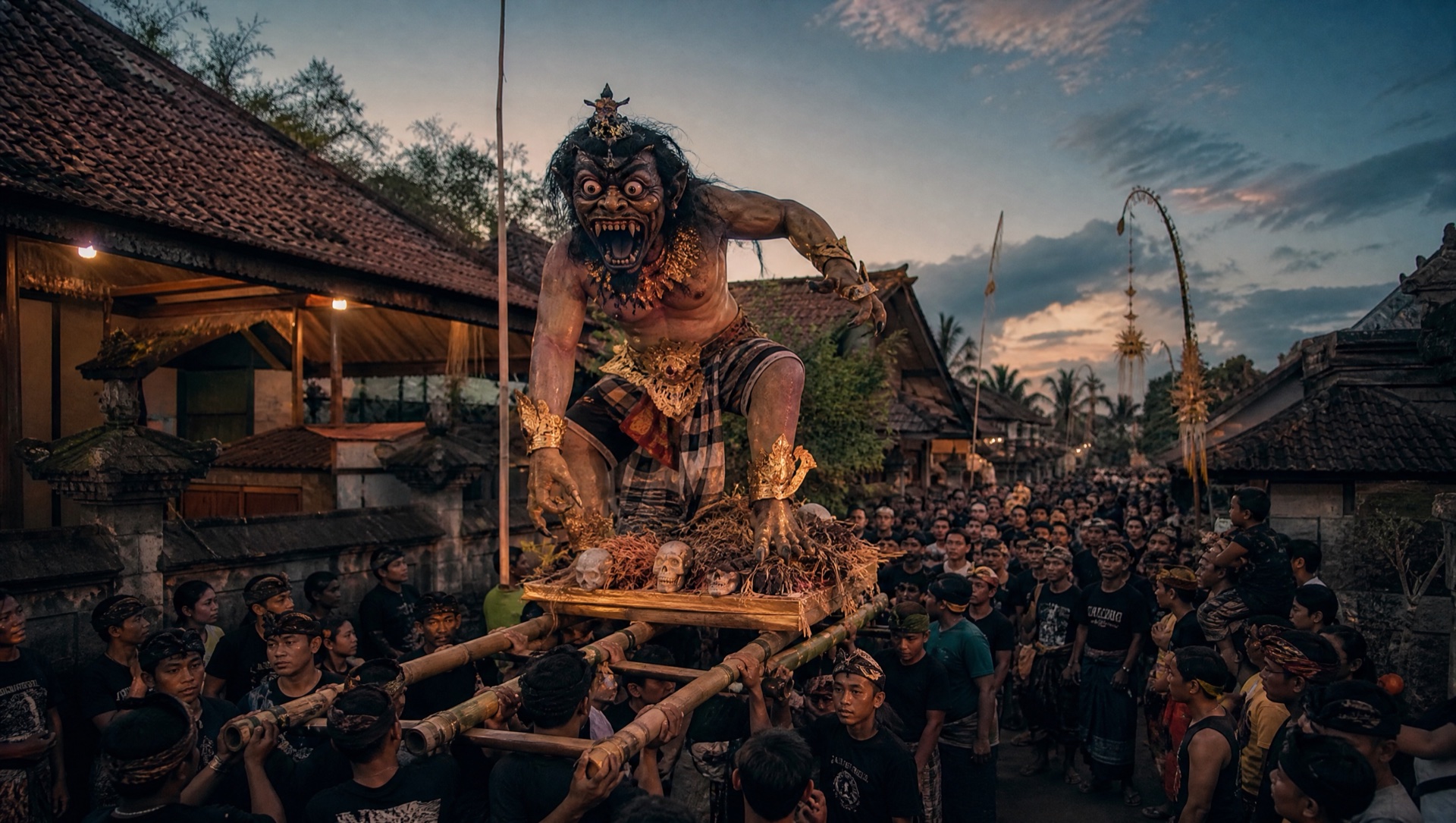
The evening before Nyepi, called Pengerupukan, is the loudest, wildest, most spectacular night on the Balinese calendar, and the perfect mirror of the silence that follows. Every village spends weeks building enormous demon effigies out of bamboo and papier-mache, monstrous figures sometimes four or five metres tall, and on this night they carry them through the streets on bamboo platforms, spinning and lurching them to confuse the evil spirits, accompanied by thundering gamelan, torches and crowds of young people. The effigies represent negative forces, and parading and later burning them clears the island of bad energy before the new year.
If the Ogoh-Ogoh are out while you are in Bali, drop everything and go. This is the photo and the memory you will be telling people about for years.
When it is
Pengerupukan is the night before Nyepi, so it follows the Saka calendar and moves each year. The next dates: 8 March 2027, then 25 March 2028. Effigies usually start gathering in the late afternoon, and the parades build through the evening, with the biggest moments after dark from roughly 6pm to 9pm.
Where to see it
The good news: you do not have to chase it. Every village (banjar) on the island holds its own parade, so wherever you are based you will find one nearby. That said, a few places do it bigger.
Denpasar, Catur Muka and Puputan Badung. The provincial capital runs the largest, most competitive parades, with the most ambitious effigies, judged for craftsmanship. The area around the Catur Muka statue and Puputan Badung square is the epicentre. Catur Muka, Denpasar. Big crowds, big effigies, serious traffic.
Ubud, around the Palace and Jalan Raya Ubud. More manageable than Denpasar, very atmospheric, with the main road closing to traffic as the effigies come through. A good choice if you want scale without the full Denpasar crush. Ubud Palace.
Your own neighbourhood. Honestly, some of the best moments are the small village parades, where you are standing among families rather than tourists. Ask your villa or homestay where the local banjar is gathering. In Sanur, Seminyak, Canggu and the Bukit, the local parades are easy to reach on foot.
How to enjoy it properly
Get into position before dark and on foot. Roads close, traffic is gridlocked, and ride apps grind to a halt. Walk to your spot and arrive by late afternoon.
Stand at the edge, not in the path. The effigies are heavy and the teams carrying them swing and spin them deliberately. Give them room and never get between the platform and the crowd it is moving toward.
Bring small notes and patience. Some viewing areas have food stalls; the atmosphere is festive and family-friendly. It is loud by design, so the noise is the point, not a problem.
Plan your exit. Once it winds down, everyone leaves at once into closed roads, and the next morning is Nyepi, when nothing moves. Be back at your accommodation before midnight, because the silence rules begin at 6am and the mood shifts fast.
The shot
This is one of the best night-photography opportunities in Bali, and it rewards a bit of technique.
The effigies themselves: shoot them lit from below by torches and street light for maximum menace. The faces are grotesque and detailed, so get in close on the sculpting before the parade starts moving, while they are still staged and lit.
The motion: as the teams spin the effigies, drop your shutter to around 1/15 to 1/30 of a second and pan, so the carriers blur and the demon stays sharp. The chaos in the frame is what sells it.
The fire and the faces in the crowd: the torchlight on young faces, the gamelan players, the sweat and effort of the carriers. These human frames often beat the effigy shots.
For Instagram: the vertical hero is a towering effigy shot from low and close with the night sky behind it and torch glow underneath. Get low, shoot up, and let it loom. No flash, push your ISO, brace against something for the slow frames.
A word on respect: this is a religious event, not a haunted house. Do not climb on platforms, do not block the procession for a photo, and do not use a drone over the crowds. Shoot from the edge and keep out of the way.
Sean’s take
Sean’s take: Ogoh-Ogoh is my favourite night of the year to shoot in Bali, full stop. The energy is unreal and the craftsmanship on these effigies would not look out of place in a film studio. Skip the idea of finding the single best parade. Walk to your nearest village one, stand with the locals, get low with your camera, and let the night come to you. Then be home before the silence lands.