
festival
Bali Kite Festival: giant kites over Sanur
Ten-metre traditional kites flown by teams of dozens fill the Sanur sky every July. Where to watch the Bali Kite Festival, when to go, and how to shoot it.
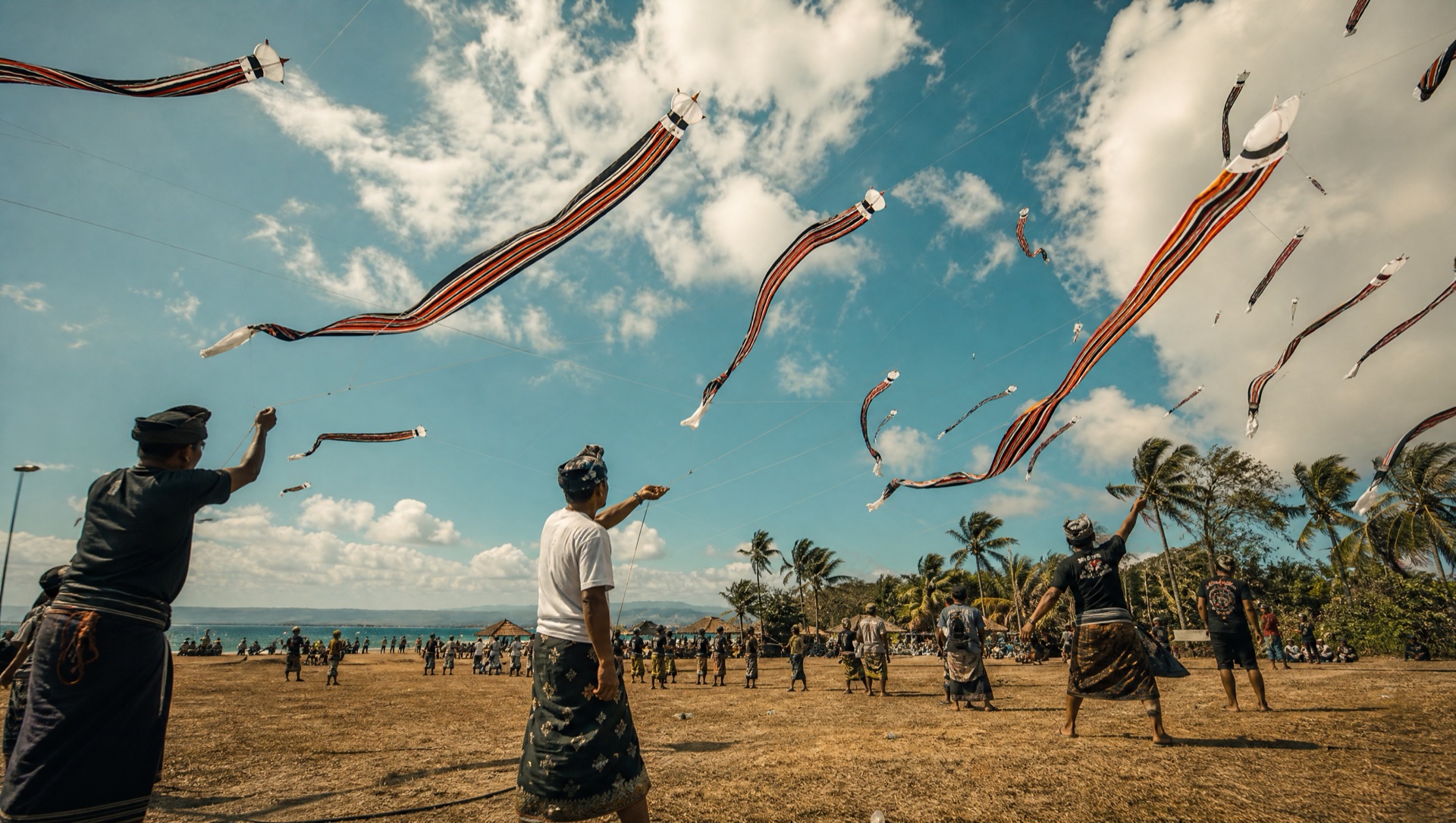
Every dry season, the wind comes up and the skies over Sanur fill with some of the largest kites you will ever see. The Bali Kite Festival is a fierce, joyful, deeply traditional competition where teams of 70 to 80 people from villages across Denpasar build and fly enormous kites, some ten metres long with tails trailing hundreds of metres behind, each team with its own gamelan band hammering away as they haul the ropes in unison. It is loud, chaotic and genuinely jaw-dropping in scale.
It started as a religious offering, a message of thanks to the gods for a good harvest, and it still carries that meaning under the competition. For visitors it is free, easy and one of the most purely fun spectacles on the island.
When and where
Kite season runs through the dry months, roughly June to September, when the winds are strongest, and you will see kites over beaches and rice fields island-wide the whole time. The main competition, the Bali Kite Festival proper, peaks in July, usually with the biggest days in late July, at Padang Galak Beach just north of Sanur. Exact competition dates are set close to the time and depend on wind and the Balinese calendar, so check locally when you arrive.
Padang Galak Beach, Sanur is the main festival ground: a wide black-sand field with the space for dozens of giant kites at once. Padang Galak Beach.
Satellite competitions run on nearby beaches through July, including Mertasari Beach in southern Sanur and Masceti Beach in Gianyar. Mertasari Beach.
The kites
Three traditional forms dominate, and knowing them makes the watching better. Bebean is fish-shaped and broad. Janggan is the bird, with a long flowing tail that can run hundreds of metres and is considered the sacred one, blessed before it flies. Pecukan is leaf-shaped and the trickiest to keep stable. Teams compete on launch, flight time, control and the drama of the crash, and a tangle or collision is read as the gods having their say.
How to enjoy it properly
Go in the morning. Competition kites launch early, around or shortly after sunrise, to catch the cleanest coastal winds. It is also cooler and the light is better.
Bring water, sun cover and something to sit on. It is a long, hot, festive few hours on an open beach with gamelan playing and crowds cheering.
Stay well clear of the launch zones and the lines. These kites are huge and the ropes run taut across the sand under serious load. Watch where the teams are working and keep behind them.
Nothing to pay, nothing to book. Just turn up at Padang Galak in the morning. Pair it with a Sanur sunrise walk and a sate lilit lunch nearby and you have a perfect Sanur morning.
The shot
This is a wide-and-up event with great human detail at ground level.
The hero frame is the sky full of giant kites at once, shot wide with a clean patch of blue, ideally with one enormous Janggan tail snaking across the frame. A long tail trailing into the corner gives you scale and movement.
At ground level, shoot the teams: dozens of people leaning back on a single rope, the gamelan players, the moment of launch when the kite lurches up. These effort-and-teamwork frames are often stronger than the sky shots.
For an aerial perspective without a drone, a rooftop bar in Sanur (the Artotel rooftop is the known one) gives you a panorama over the action. For a clean portrait away from the crowd, the quieter end near Mertasari works.
For Instagram: the vertical hero is a single colossal kite low in the frame with its tail leading up and out, a person or team small beneath it for scale. Shoot into open sky, expose for the kite, and keep the horizon low. A drone is risky here for obvious reasons, lines everywhere and crowds, so keep it grounded.
Sean’s take
Sean’s take: People do not expect to love the kite festival and then they cannot stop watching. The scale is the thing; photos undersell it until you are standing under a ten-metre fish held up by eighty blokes and a gamelan band. Get to Padang Galak in the morning while the wind is clean, stay behind the teams, and shoot wide. It is one of the best free mornings in Bali, and it is right on Sanur’s doorstep.