
ceremony
Galungan and Kuningan: the island of Penjor
Bali's most important festival, when every street fills with towering decorated bamboo poles. What Galungan means, when it falls, and where to photograph the best Penjor.
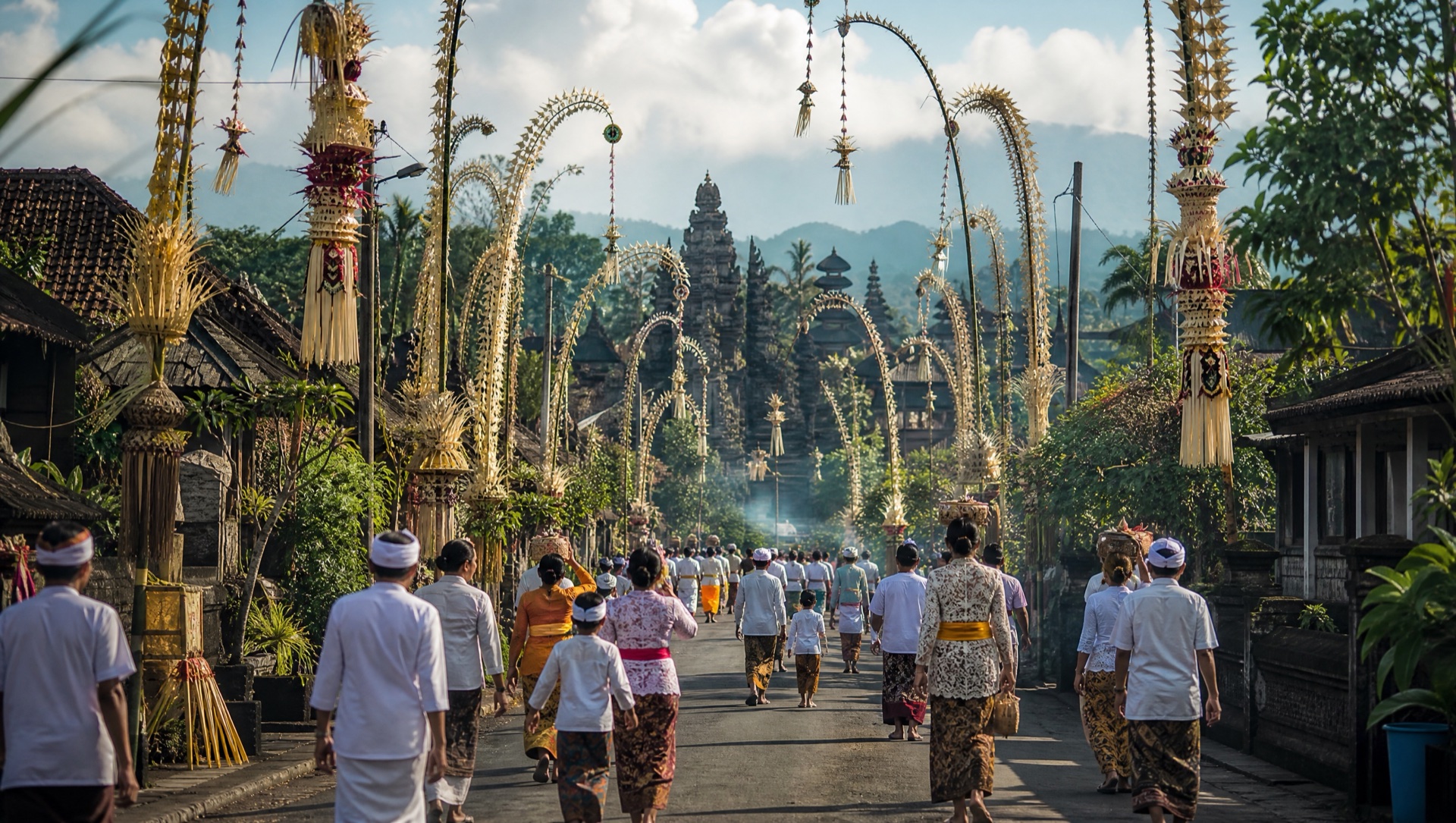
For about ten days, twice a year, Bali transforms. Overnight, tall curved bamboo poles called Penjor rise outside every home, temple and business, arcing over the roads, each one tipped with a hanging ornament of coconut leaf, rice, fruit and flowers. Drive any village lane and you pass under a dreamlike archway of them. This is Galungan, Bali’s most important festival, celebrating the victory of dharma (good) over adharma (evil) and the return of ancestral spirits to their family homes. Kuningan, ten days later, sees the spirits off again.
Unlike Nyepi, the island stays open and running throughout, so you can witness all of it, the Penjor, the temple ceremonies, the families in their finest, as long as you do it respectfully. For a photographer, it is the most visually rewarding window in the Balinese year.
When it is
Galungan and Kuningan run on the 210-day Pawukon calendar, which means they come round roughly every seven months and usually land twice in a Gregorian year, on different dates each time. Penjor go up the day before Galungan and stay until the end of Kuningan, so you get about ten days of poles island-wide.
Verified dates: Galungan 17 June 2026, Kuningan 27 June 2026. In 2027 the cycle lands twice: 13 and 23 January, then 11 and 21 August. Always confirm the current dates, because they shift every year.
What you are looking at
A Penjor is a bamboo pole 5 to 10 metres long, bent so the decorated tip curves gracefully over the street. The curve is said to echo Mount Agung, the island’s holy mountain. Halfway down sits a small offering shrine called a sanggah cucuk. The materials, coconut, banana, sugarcane, rice, stand for the earth’s generosity and the household’s gratitude. Every family makes or buys their own, so no two are the same.
The styles even change by region. In Karangasem (East Bali) the poles tend to be stouter and more natural. In artistic Tabanan they get intricate, with elaborate woven janur. In Ubud and Denpasar you see everything from minimal to extravagant.
Where to see the best Penjor
Penglipuran Village, Bangli. This is the money shot. Penglipuran is a famously tidy traditional village with a single symmetrical stone street running uphill, and during Galungan every house raises a Penjor along it, turning the whole village into a corridor of arcing poles. It is the single most photogenic Penjor location on the island. Open roughly 8am to 6:30pm, small entry fee. Penglipuran Village.
Ubud and its villages. Walk or cycle the lanes off Jalan Raya Ubud and through Penestanan and the rice-field paths. Less of a single set-piece than Penglipuran, more an immersive wander under poles with daily life going on around you. Ubud.
East Bali, around Sidemen and Karangasem. Quieter, more traditional poles against a backdrop of rice fields and Mount Agung. If you are based in the east for Galungan, the village roads here are beautiful and tourist-free.
Anywhere, honestly. Because every household raises one, even the main roads of Seminyak and Canggu get dressed up. You do not have to travel far to be among them; the special trip is for Penglipuran.
To pair the Penjor with temple ceremony, the great mother temple of Besakih on the slopes of Agung is the spiritual heart of it. Besakih Temple.
How to enjoy it properly
Galungan morning is family time. Families pray at home temples and village temples in their best traditional dress. If you visit a temple, wear a sarong and sash, stay at the back, and do not walk in front of people praying or point your camera into their faces.
Drive or walk the villages rather than rushing between sights. The pleasure is the immersion, the slow pass under hundreds of poles, not ticking off a list.
Go early for Penglipuran. It is popular and gets busy with day-trippers and influencers by mid-morning. Arrive at opening for clean light and an emptier street.
Roads can be busy with ceremony traffic, and many Balinese take time off, so plan a relaxed pace.
The shot
The Penjor are the gift here, and the best frames play with their shape and the light.
At Penglipuran, shoot straight up the symmetrical street so the rows of poles converge and arc overhead; the symmetry is the whole point, so centre your composition. Go at opening or near closing for soft light and fewer people.
For the curve, position so a single Penjor sweeps across your frame against open sky, and shoot at golden hour with the sun behind it so the translucent coconut-leaf ornaments glow.
In the villages, look for the contrast of a towering pole over an ordinary scene, a scooter, a dog, an old gate. That juxtaposition is more interesting than a pole alone.
For Instagram: the vertical hero is the Penglipuran street, shot low and centred so the poles form a tunnel leading the eye uphill. Early morning, no crowds, slight backlight. A drone is tempting for the rows, but Penglipuran is a living village with prayers happening, so keep it grounded and respectful, and never fly over a ceremony.
Sean’s take
Sean’s take: If your trip lands in a Galungan window, you have got lucky, because the whole island turns into a film set for ten days and most visitors do not even know why. Get to Penglipuran at opening for the corridor of poles, then spend the rest of the day just wandering Ubud’s lanes underneath them. Wear a sarong, keep your camera respectful around the praying, and soak it up. It is the most beautiful Bali gets.