
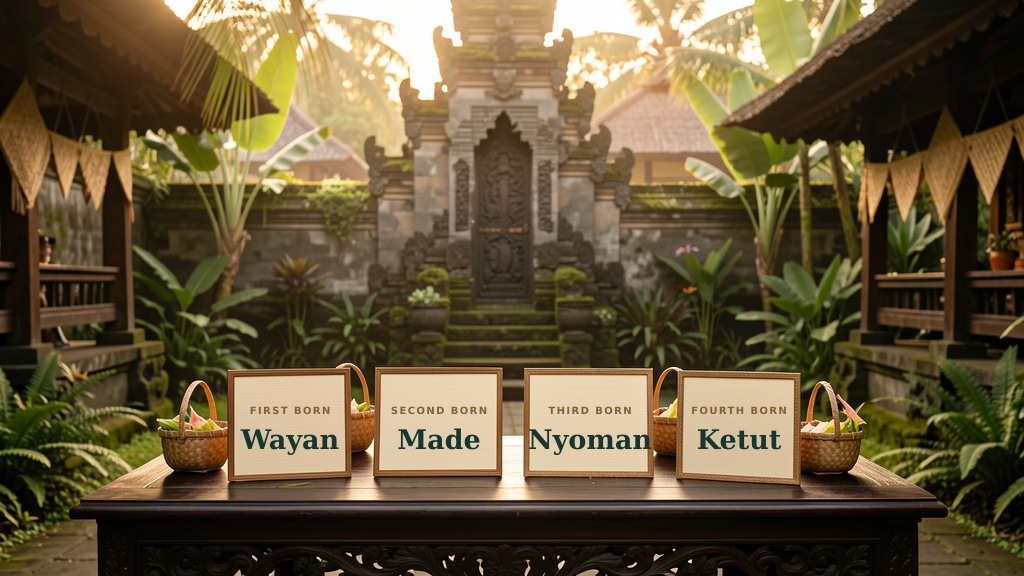
Spend more than a day in Bali and you will probably meet a Wayan. Stay a little longer and you will meet another Wayan, several Mades, a Kadek, a Komang and at least one Ketut. It can feel as though an entire island is sharing the same handful of first names.
The short explanation is that these are usually birth-order names. They tell you whether someone was the first, second, third or fourth child in their family. But the real system is richer than the familiar Wayan–Made–Nyoman–Ketut sequence. There are alternatives for each position, the cycle can repeat after the fourth child, and a Balinese name may also carry gender markers, hereditary titles and a personal name chosen by the family.
So Wayan is not quite the Balinese equivalent of John, and Made is not just an unusually popular given name. They are clues to family order—and one of the first pieces of Balinese culture that begins making sense once you live here.
The four-name cycle
First child: Wayan, Putu or Gede. Wayan is connected to wayah or wayahan, referring to the eldest or oldest. Putu can mean grandchild, while Gede means big or great. Wayan and Putu can be used for any gender. Gede is most commonly male, while a woman may be called Luh Gede. Here Luh marks gender; it is not a separate first-born position.
Second child: Made, Kadek, Kade or Nengah. Made—pronounced approximately Mah-deh, never like the English word “made”—is linked to the Sanskrit/Old Javanese madhya, meaning middle. Nengah is similarly related to “middle”. Kadek or Kade is associated with adi, a younger sibling.
Third child: Nyoman or Komang. These are the standard alternatives for number three. The etymology is less settled than many quick travel articles imply. Linguistic research records proposals connecting Nyoman to anom, meaning young, and also notes other local explanations. It is safer to treat Nyoman and Komang as established third-born markers than to insist on one neat translation.
Fourth child: Ketut. Ketut is the fourth position and has no alternative with the same everyday reach. One linguistic account derives it from ketuut or ketuwut, “to follow behind”. You will also see the charming “little banana at the end of the bunch” explanation repeated online, but the scholarly sources are not unanimous, so I would not present that story as settled fact.
What happens with a fifth child?
The sequence can begin again. A fifth child returns to the first position, a sixth to the second, a seventh to the third and an eighth to the fourth. Families may distinguish the later round with words such as Balik (“return”) or Tagel (“fold/repeat”), with Alit (“small/younger”), or with another personal name. A fifth-born person might therefore be called Wayan Balik, Putu Alit or simply use a repeated first-position name in daily life.
This is a living convention, not a serial-numbering law. Families choose among variants, and practice differs by region, lineage, generation and personal preference. A 2023 anthropology paper from Udayana researchers also describes the Muslim village of Pegayaman in North Bali using the classic sequence Wayan, Nengah, Nyoman and Ketut alongside Islamic personal names. That is a useful reminder that Balinese cultural identity and religious identity do not always fit the simple boxes visitors expect.
What do I and Ni mean?
The short words at the front are usually gender markers: I is the male marker, while Ni is the female marker. I is pronounced roughly “ee”, while Ni is close to “nee”. They are not initials. In linguistic terms they function as articles or name markers, so I Wayan identifies a male Wayan and Ni Made a female Made.
They are common, but they are not attached to every Balinese name in every setting. You may hear them dropped in conversation or see other gender-bearing titles instead. Luh is a female marker, not a birth-order name, and can appear with an order name in forms such as Ni Luh Made or Luh Gede. Bagus and Ayu also distinguish male and female names in some title systems.
A name may tell you more than birth order
Traditional Balinese names can be built in layers. Depending on the family, a name may include a gender marker, a hereditary wangsa title, a birth-order element and an individual personal name. Unlike a typical Western surname, the final element is not necessarily a family name passed unchanged from parent to child.
Titles such as Ida Bagus and Ida Ayu are associated with Brahmana families. Names including Anak Agung, Cokorda, Gusti, Dewa, Desak or other titles can signal different hereditary backgrounds. Birth-order names are especially associated with the broad jaba or Sudra majority, but they can also appear beside titles. Modern Balinese naming is flexible, and many families adapt, abbreviate or move away from older formulas.
This is why “all Balinese people have only four names” is catchy but wrong. Those four positions are a shared framework. The personal names and titles around them distinguish real people, families and histories.
Where did the custom come from—and how old is it?
There is no reliable date for the exact beginning of the birth-order system, and no credible account of one ruler inventing it in a particular year. Academic descriptions treat it as an inherited Balinese naming tradition. It appears across communities identified with both Bali Aga and later Bali-Majapahit cultural histories.
What we can date is the written record. V. E. Korn discussed Balinese customary naming in Het Adatrecht van Bali, first published in 1924 and revised in 1932. Miguel Covarrubias then recorded the Wayan–Made/Nengah–Nyoman–Ketut sequence and its repetition in Island of Bali in 1937. The system has therefore been documented as customary for about a century, and those writers encountered it as an established tradition rather than a new invention.
The words themselves preserve older linguistic layers: wayah for old or eldest, madhya for middle, adi for younger sibling and anom for young are Balinese, Sanskrit and Old Javanese connections rather than modern bureaucratic labels. Researchers also connect the four-part sequence with Kanda Pat, a Balinese complex of teachings about the four spiritual siblings or forces accompanying a person from birth. One recent study argues that this fourfold religious pattern helps explain why the sequence has such cultural staying power.
That connection is meaningful, but it should not be turned into a false origin story. Similarity to Kanda Pat is evidence about cultural meaning, not a dated birth certificate for the naming custom. The honest answer is that the convention is old, was firmly documented by the early 1900s, and likely draws on older Balinese and Old Javanese concepts—but the evidence does not tell us whether it began 500, 800 or 1,000 years ago.
Why my friends call me Pak Kadek
My Balinese friends call me Pak Kadek. Pak is the respectful everyday address for an adult man, and Kadek is their adopted birth-order name for me because I am the second born in my family. It is not on my passport, but it makes immediate sense here.
It is also much easier than Sean.
English spelling gives almost no help with that name: the written “Sean” is pronounced “Shawn”. Indonesian spelling is generally much more transparent. Standard Indonesian does include the /ʃ/ sound, usually written sy in loanwords such as syarat and masyarakat, but speakers do not all realise it in exactly the same way. A 2024 study of Indonesian-accented English found that many participants produced English /ʃ/ successfully, while /s/ substitution also occurred.
So when a Gojek driver sees S-E-A-N on the screen, “Seh-ann” is a perfectly understandable reading. I can explain the Irish spelling, repeat “Shawn”, or simply answer to Pak Kadek. In Bali, the last option usually gets the warmer smile.
The useful way to ask
If you meet three Wayans in one day, do not assume their names are interchangeable. Ask, “Are you the first born?” and you have an easy opening into a real conversation about siblings and family. If someone gives you a longer personal name, use the version they introduce themselves with rather than trying to decode every title yourself.
The system is fascinating because it turns a name into a small piece of family geography. Wayan, Putu, Made, Kadek, Nyoman, Komang and Ketut are common for a reason—but every person carrying one of them still has a name, story and place in Bali that is entirely their own.
Sources and further reading
- I Gede Bagus Wisnu Bayu Temaja, “Sistem Penamaan Orang Bali”, Humanika 24(2), 2017/2018.
- Aliffiati, Ida Bagus Oka Wedasantara and Gede Budarsa, “Ketut Muhammad: Sistem Penamaan Diri Muslim Pegayaman di Bali”, Umbara 8(1), 2023.
- Nengah Bawa Atmadja et al., “Name System Based on Birth Order as a Balinese Ethnic Identity in Bali Indonesia”, 2023.
- Miguel Covarrubias, Island of Bali, 1937.
- Abdi Rahmat Syam, Sheena Gardner and Michael Cribb, “Pronunciation Features of Indonesian-Accented English”, Languages, 2024.